14 June, Liverpool, England
Oops! We’ve arrived at our AirBnB in Liverpool, England, and it was occupied. I’d inadvertently booked a room, not a whole flat. Well, nothing to do but move into the postage stamp bedroom and enjoy the clear blue skies, our first in several days. But I have gotten ahead of myself …
Intro for newcomers, all others feel free to skip ahead a few paragraphs. When I joined the Peace Corps at age 46 in 1991, I started circulating a letter to family and friends about my new experiences. As I lived and worked in Poland and later in the Balkans and East Africa, the letter eventually morphed into the original “Hello All” blog.
As a result of my overseas work, I now serve on the board of the Center for Support of Entrepreneurship in Sandomierz, Poland. The Center was established 25+ years ago under grants from USAID and several US foundations. Your tax dollars at work! In 1994-95, I managed that USAID project, helping it become an independent, self-sustaining foundation. My last task was the Center’s first board meeting. I joined the board 10 or so years later. Thus, twice a year I travel back for board meetings in Sandomierz and add on visits with friends in Warsaw and other European cities.
Glenn is my significant other. We met in first grade, graduated high school in the same class and didn’t see each other again until our 50th class reunion. Contact re-established, relationship initiated and by our 70th birthdays, we were a couple living separately. We still live separately— I in the Big City (Pittsburgh) and Glenn an hour away in the Small Town (Mount Pleasant, not too far from his daughters and granddaughters). Two trips to Italy and a transit through Charles De Gaulle Airport were the sum of his overseas travel BS (Before Suzi). Now he’s been to Poland, Holland, England, Scotland … and more to come!
FROM THE BEGINNING …
Flying to Poland via DC and London meant saving on our Delta/Virgin airfares even with first class on the British Air legs. So off we drove toward DC on a sunny PA day. We made a rest stop at the mountain cottage of friends Inga and Craig who were there for the weekend. Theirs is the perfect place to relax — tucked away on a forested hillside with neighbors but not too close, a self contained main floor with two additional bedrooms and a bath upstairs. And nearby, a resort with all a mountain resort has to offer year round. I have relished every time I’ve been there.
Glenn’s cousin Donald graciously allowed us to leave the car at his place in Alexandria, where we spent time catching up, trying a new restaurant, returning to old favorites. Then off to Dulles. Thank you, Donald, for the ride. Even with Glenn’s slimmed down packing, we had too much for the Metro.
Our long layover in London and luggage fees were why I opted for first class on BritAir. And it was worth the few extra bucks. Our exhausted bodies relaxed into comfortable seats near the biggest array of food, beverage, amenities that I’ve seen in an airport lounge. Fast forward …
POLAND
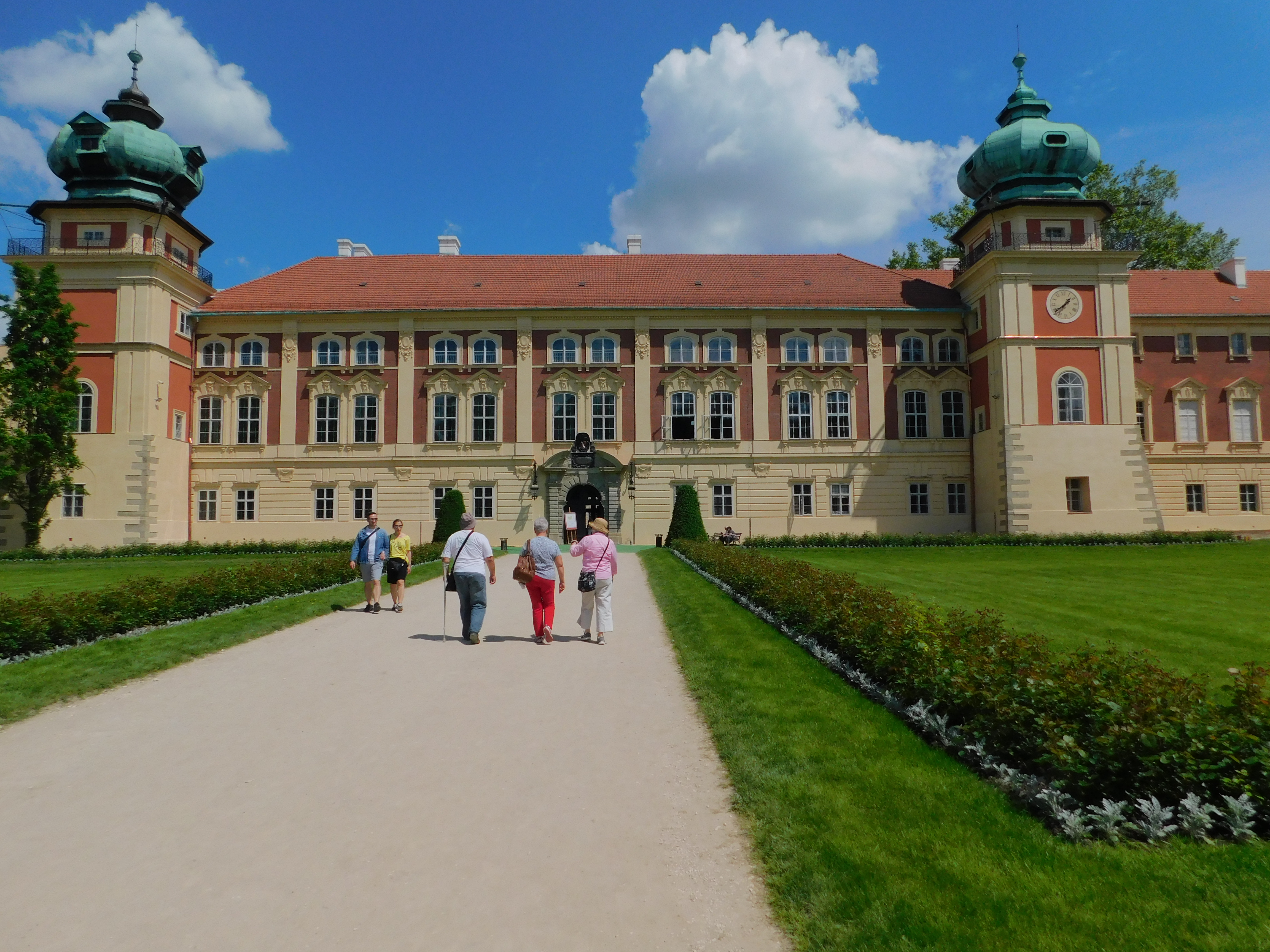
Weather in Sandomierz was ideal — sunny and warm, perfect for walking in the Old Town or enjoying friends Hala and Micheł’s farm, both of which we did. After the meeting, Hala, Micheł, Glenn and I spent a few days showing Glenn more of Poland. First, we stopped in Łańcut to tour the incredible castle that looks more like a palace than a defense facility. Herein started Glenn’s picture taking.
Micheł, Hala & I approach Łańcut Castle
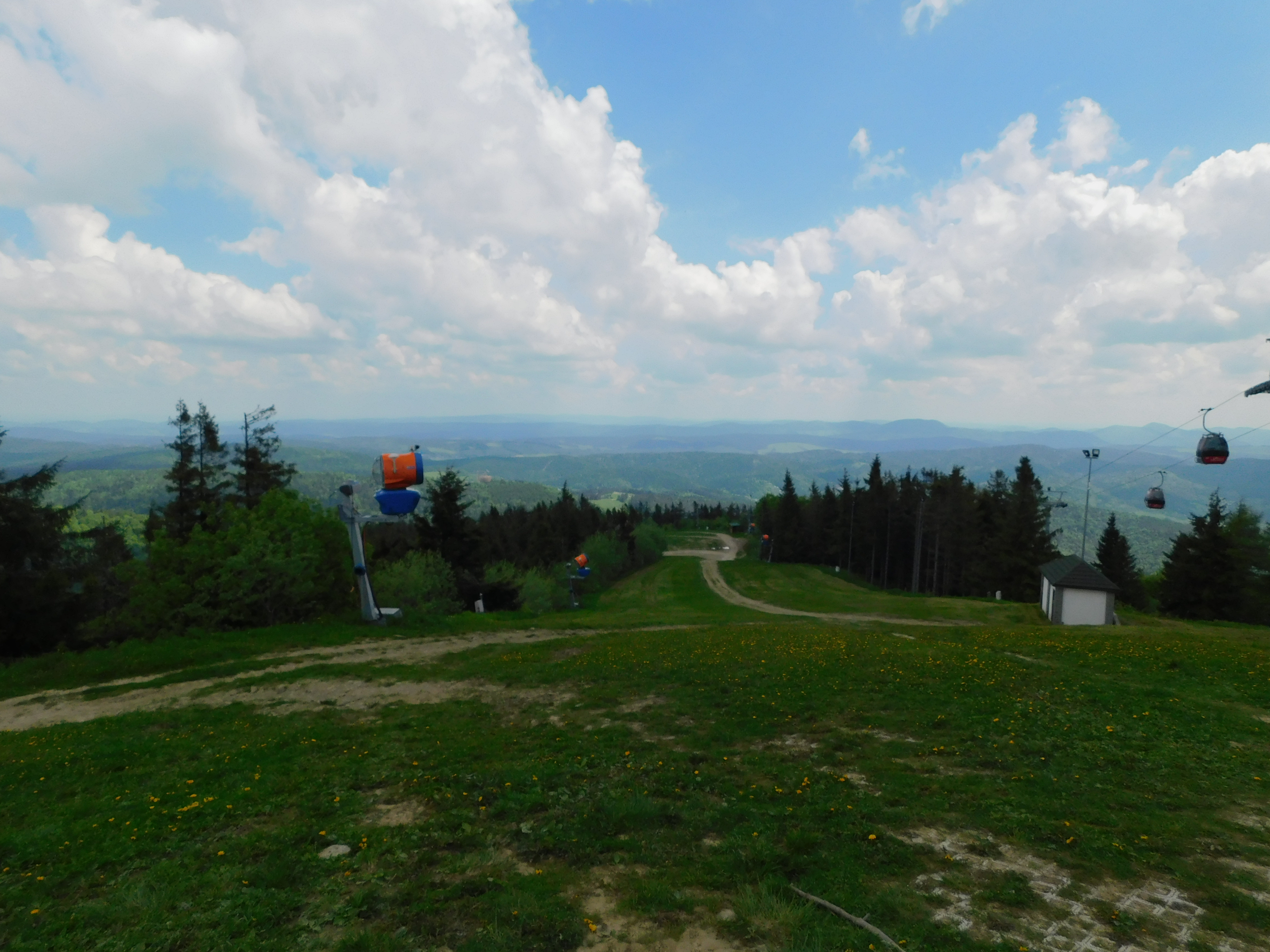
From Łańcut, we drove to Krynica, a lovely spa town in the mountains near where I did my Peace Corps service. Remnants of the Austro-Hungarian Empire remain in this picturesque town. Cooler and with less sunshine but still nice walking-around weather. We rode a gondola to the top of Jaworzyna mountain and later a funicular to the top of Góra Parkowa. Both give gorgeous panoramic views of the many variations on green on the Polish and Czech mountainsides. When we hiked or skied there as Peace Corps volunteers n the ‘90s, we joked about always carrying our passports: one wrong turn and we’d be in the former Czechoslovakia.
View from Jaworzyna
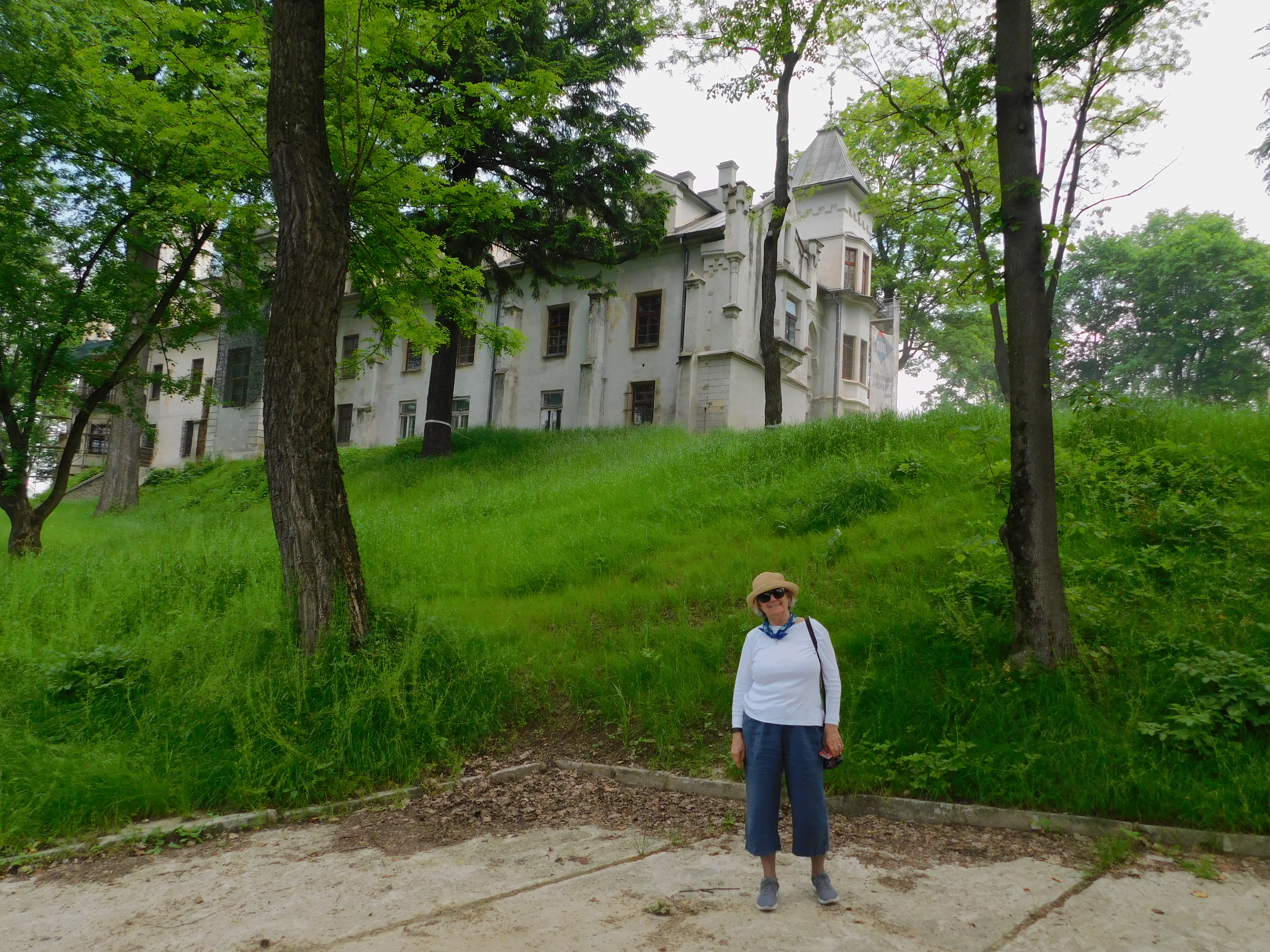
We made a stop in Nowy Sacz where I lived for two years at a PCV. My first home was an old palace that also housed a college, a print shop, offices and living space for assorted US and UK volunteers.
There I am below Pałac Stadnicki
LONDON
Aside: For our UK adventure, we had purchased BritRail passes, something we’re very glad we did. For long trips, you can reserve a seat at no additional cost … or you can hop aboard and hope for an empty seat. The trains were clean, air conditioned, on time and seem to go everywhere. With our eight-days-in-a-month passes, we could take any number of trips on any given day but use the passes on no more than eight days. When we presented them the first time (London to Liverpool), the conductor marked the date. After that, conductors looked at the passes and returned them. Frankly, we could’ve used them more than eight days.
London was rainy, nothing new to most but I’ve usually had good weather luck on summer trips. But dicey weather didn’t deter our walking whenever possible. Although part of a US hotel chain, our Comfort Inn was more reminiscent of other small London B&B hotels where I’ve stayed — tall, narrow buildings in the midst of commercial areas. Located about a mile from Paddington train station in a largely Middle Eastern neighborhood, it was fun to be in a real neighborhood rather than a tourist center … the downside was a major road that we had to get around when we walked. On our first venture back to Paddington to get the Hop On/Hop Off bus, we used my map app and walked through a pretty park and a hospital ER as well as over a canal and through a highway underpass. Glenn found us an easier way.
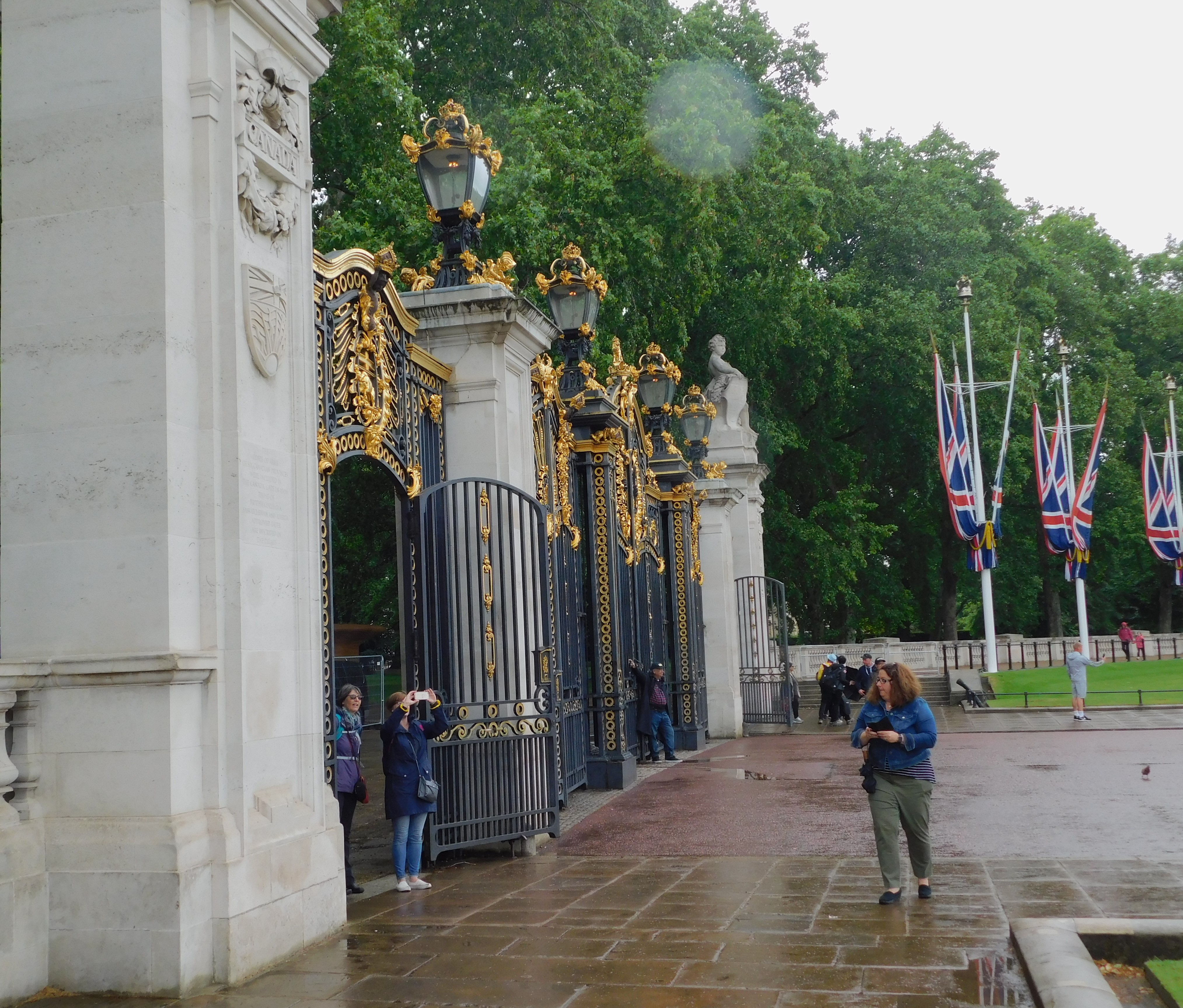
Because our trip was a short two nights and Glenn’s first to London, we opted for the bus tour to give him an overview and a chance to see major sights like Hyde Park, Buckingham Palace, Parliament, Big Ben, Westminster Abbey, et al. Because of the rain, every tourist in town was doing the same and the open air buses had limited under roof seating. But we made do and saw much of the city in our two days … Glenn took many photos and enjoyed his first pub meal at a very crowded Trafalgar Square area pub.
A rainy day at Buckingham Palace
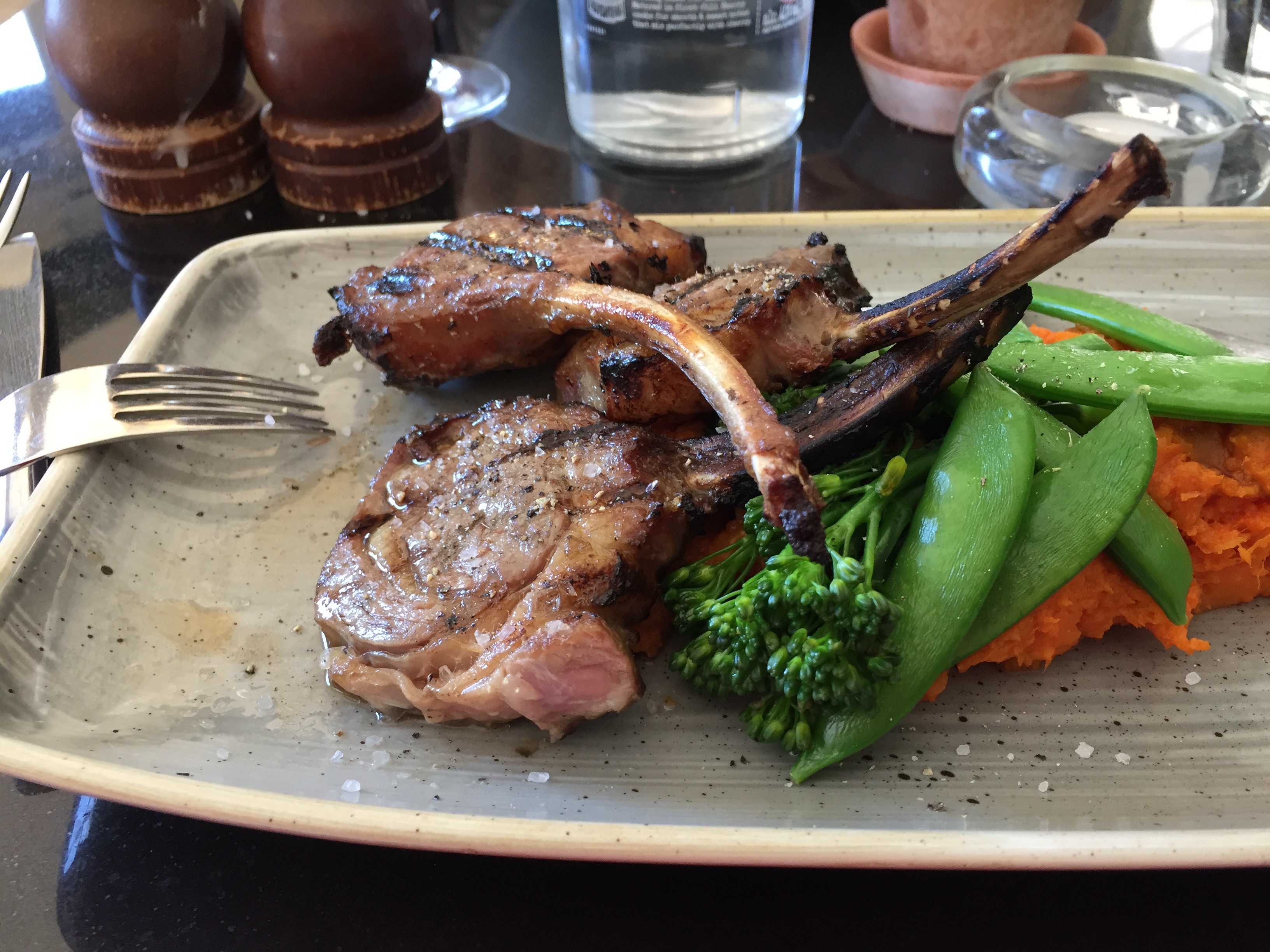
Aside: Contrary to popular opinion, food in the UK isn’t all over-cooked beef, soggy vegs and take out curries. We had some incredible meals throughout our trip: lamb chops in Perth, steak and fish in Greenock, gyros and Argentinian meats in Liverpool, medium-rare burgers in London, calamari and scampi in Edinburgh and big fresh salads everywhere. Oh, and stay tuned. Glenn tasted haggis.
Each of London’s train stations services a designated region. The hotel clerk booked a taxi to Euston Station for our trip to Liverpool; she told us the ride would be a flat fee of 30 pounds. This was a private hire, not one of London’s famous black cabs. Next morning the cabbie arrived promptly, loaded us in and was pulling into rush hour traffic when his phone rang. He said a few words, then handed the phone to Glenn. It was the dispatcher verifying that our ride would cost 15 pounds. Hmm.
At Euston, I had our BritRail passes endorsed and reserved seats on the train to Lime Street Station in Liverpool. UK trains don’t post their tracks until 10-15 minutes before departure. So we joined the throngs scanning the Departures board, then charging toward our train, look for the correct car and finally our seats.
LIVERPOOL
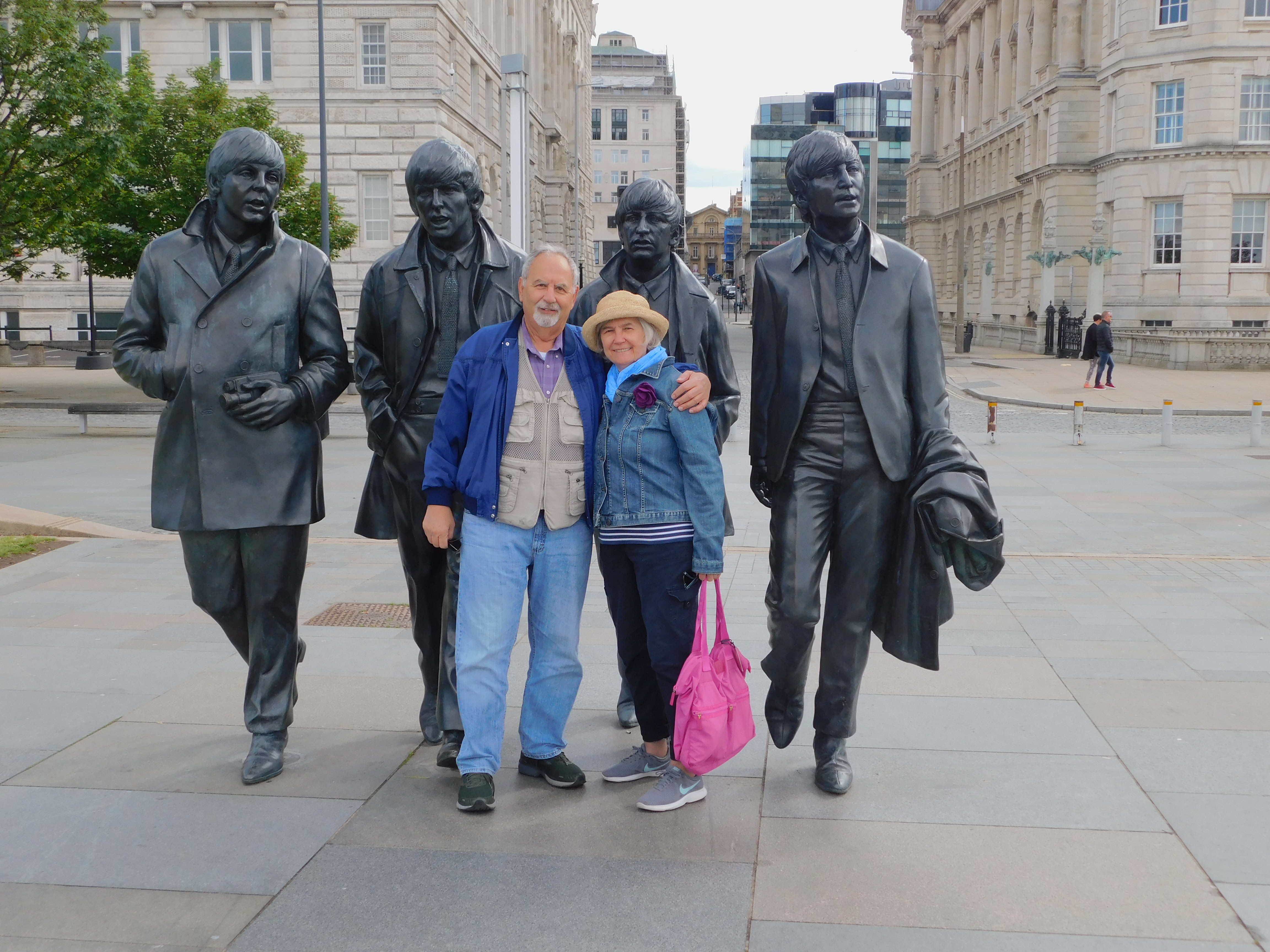
Because Liverpool was sunny and warm, we spent most of our time outdoors. We did a Beatles’ walking tour, including the Cavern Club and Beatles exhibit at the new city museum. Like every other tourist in Liverpool, we had our picture taken in front of the Beatles’ statue at the harbor. Our tour guide had shown us how each Beatles statue was personalized — John Lennon’s had cups two acorns (he and Yoko Ono planted two acorns in Coventry Garden in 1968), Paul McCartney carries a camera (perhaps in memory of his photographer wife Linda Eastman), Ringo Starr’s boot is etched with “L8,“ the post code of his childhood home, and George Harrison has Sanskrit etched on his coat belt (he traveled extensively in India).
Typical Liverpool tourists
Later we wandered the busy center city pedestrian mall and visited the Beatles’ Museum which had moved and expanded since my late son Peter and I visited in 1987. And I gritted my teeth and joined Glenn in the elevator to the top of the television tower. Ventured just enough at the top to make the discounted tickets worthwhile.
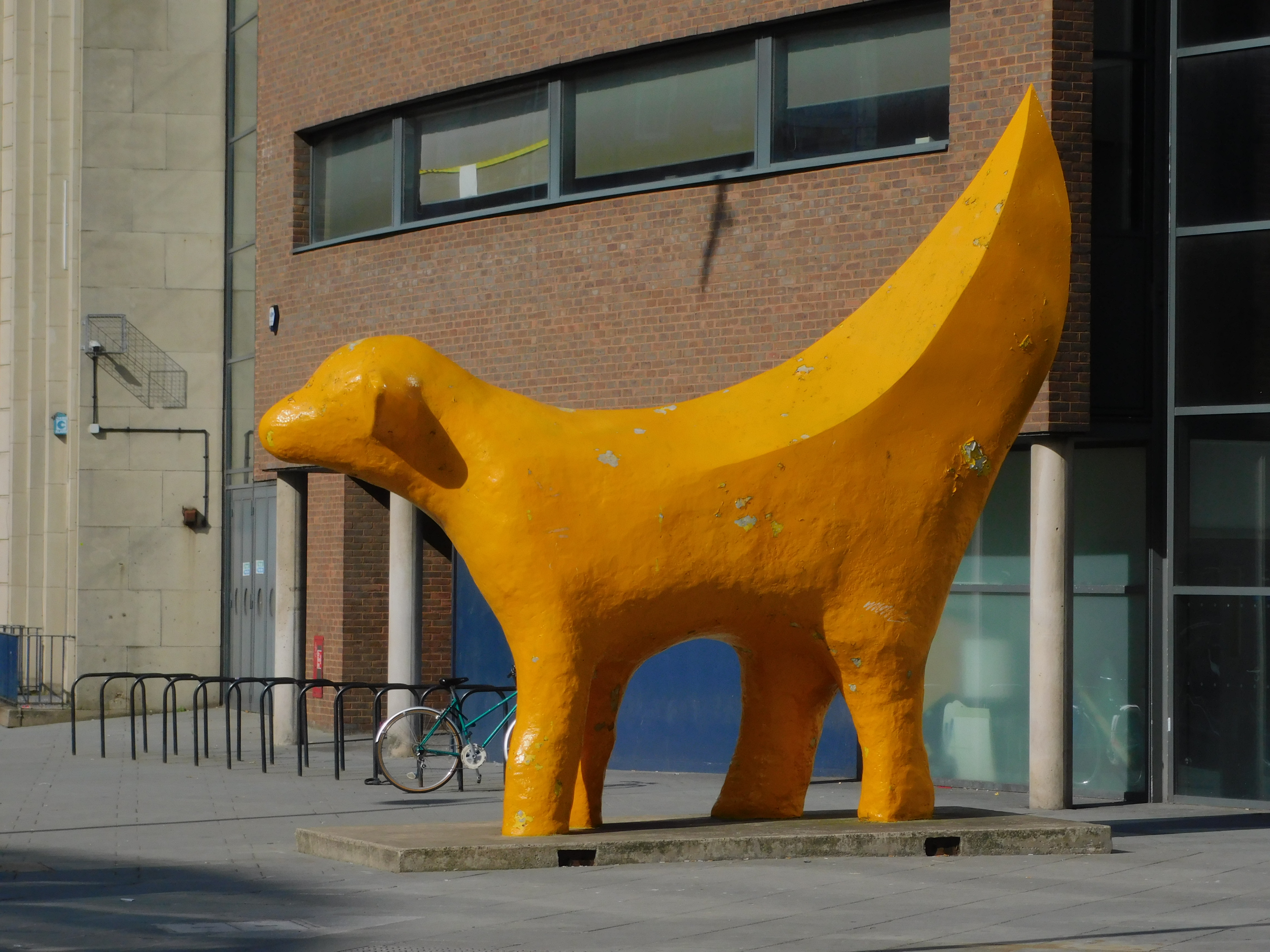
The Bananalamb, Liverpool’s answer to Chicago’s bulls, St. Paul’s Snoopys, et al.
EDINBURGH
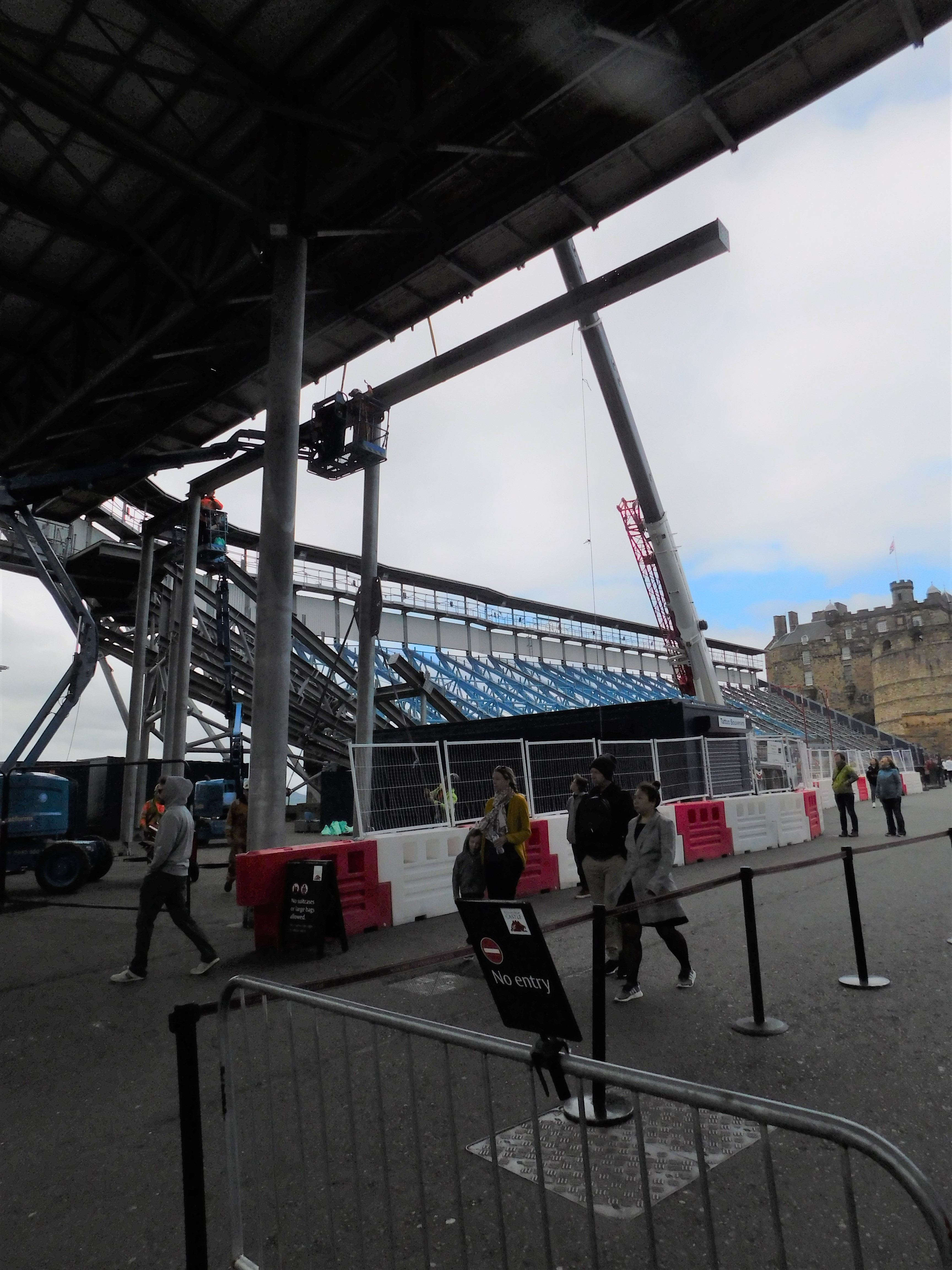
Edinburgh was our next stop. Our flat was in the New Town, the largest Georgian planned town in the world. It was a long, generally uphill climb to Princes Street shopping and on to the Royal Mile, so we taxi’d to Edinburgh Castle. Glenn was flabbergasted at the crew installing metal bleacher type seats for the coming Edinburgh Tattoo (an annual military exhibition). A crane was moving a long I-beam over the heads of tourists slogging up to the castle entry. OSHA would have had a fit!
Construction at Edinburgh Castle
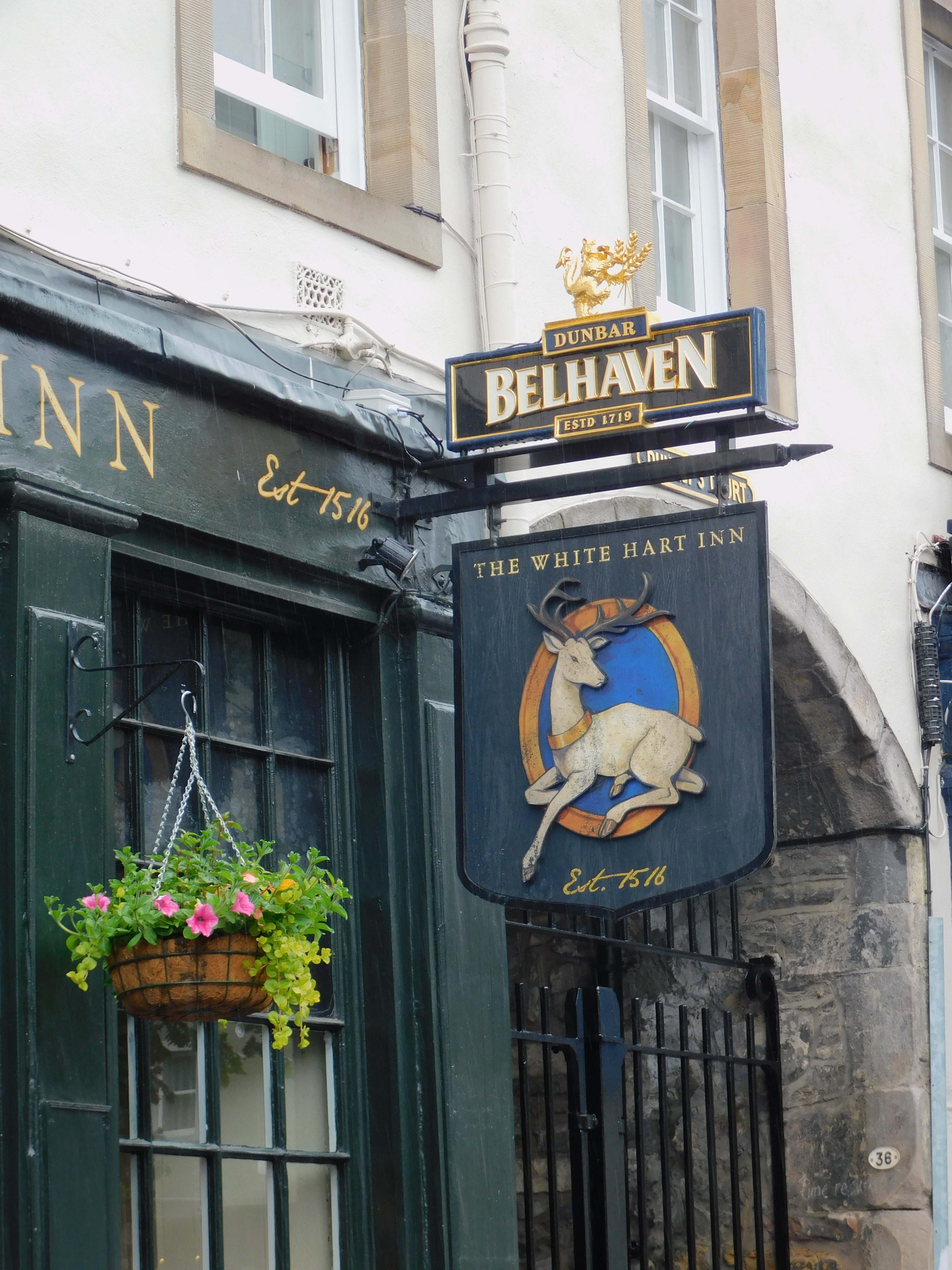
More rain and overcast days, another good time to use the Hop On/Hop Off travel option to give Glenn an overview of the city, including the contemporary Scottish Parliament Building, which I hadn’t seen before. We hopped off at Grassmarket, traditional location of public executions, to have lunch in the White Hart, the oldest pub in Edinburgh, and later to explore the National Museum, in an old factory. Returning in the rain, we found an excellent Italian restaurant with room for two more diners.
Oldest Pub in Edinburgh serves a fine lunch
My kind of cafe!
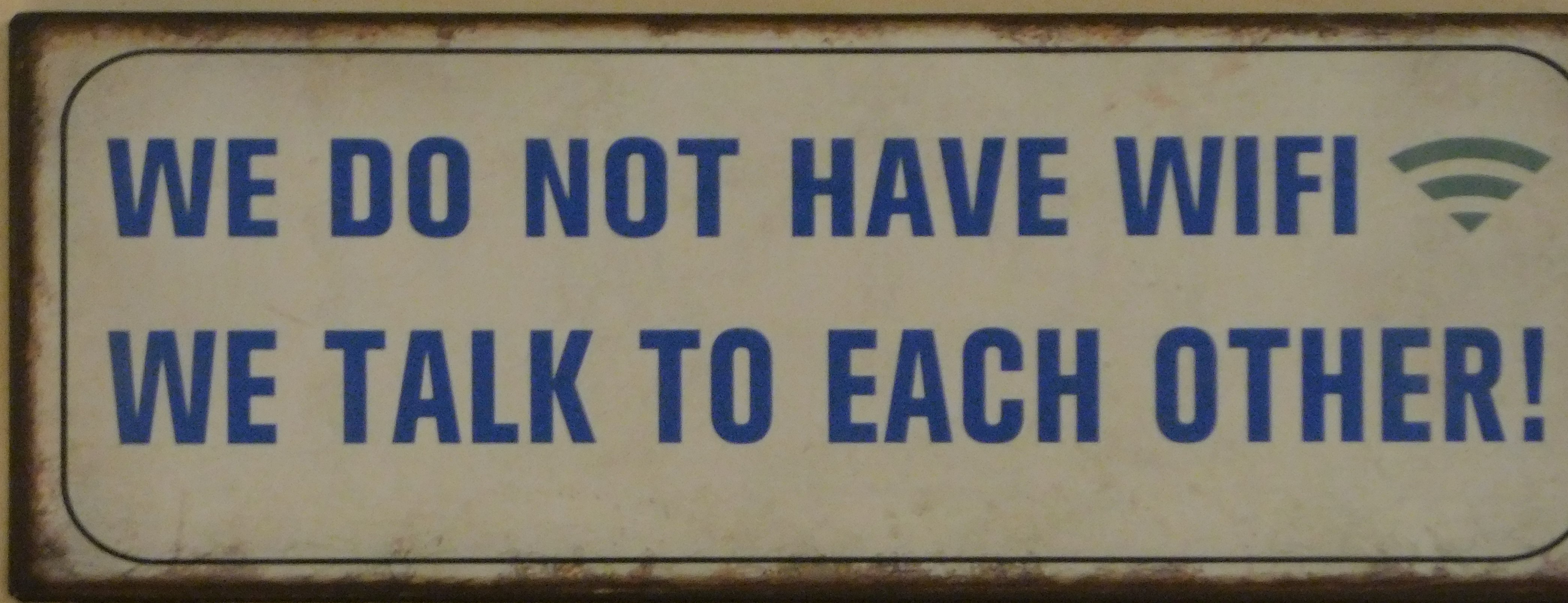
After booking our day trip to Stirling, we wandered the Royal Mile for lunch. Down a narrow path between two buildings, we found a lovely courtyard (unusable due to rain) and a crowded cafe (with the above sign). We stayed, ate well and talked!
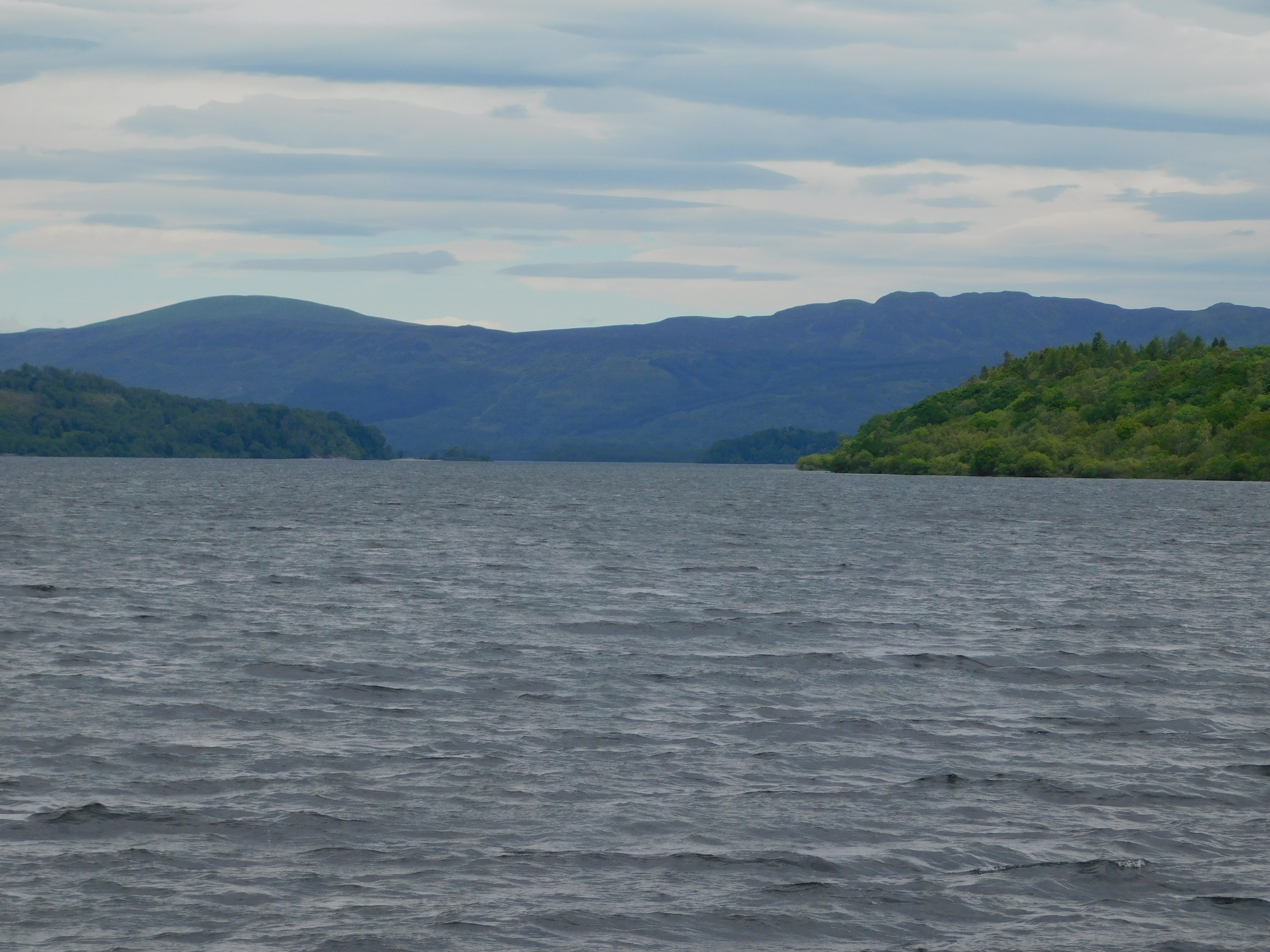
The next day we arose at the crack of dawn and hailed a cab to return to the Royal Mile to catch our bus to Loch Lomond, the largest lake (by area) in Great Britain, and Stirling Castle, one of the largest and most important castles in Scotland. Loch Lomond is 22+ miles at its longest and 5 miles at its widest. We boated for about an hour among several of the 30 islands in the lake, Glenn snapping photos of the Muir Mountains, a large number of grazing sheep and other sights. I think he took even more pix at Stirling.
Muir Mountains from Loch Lomond
The formidable Stirling Castle
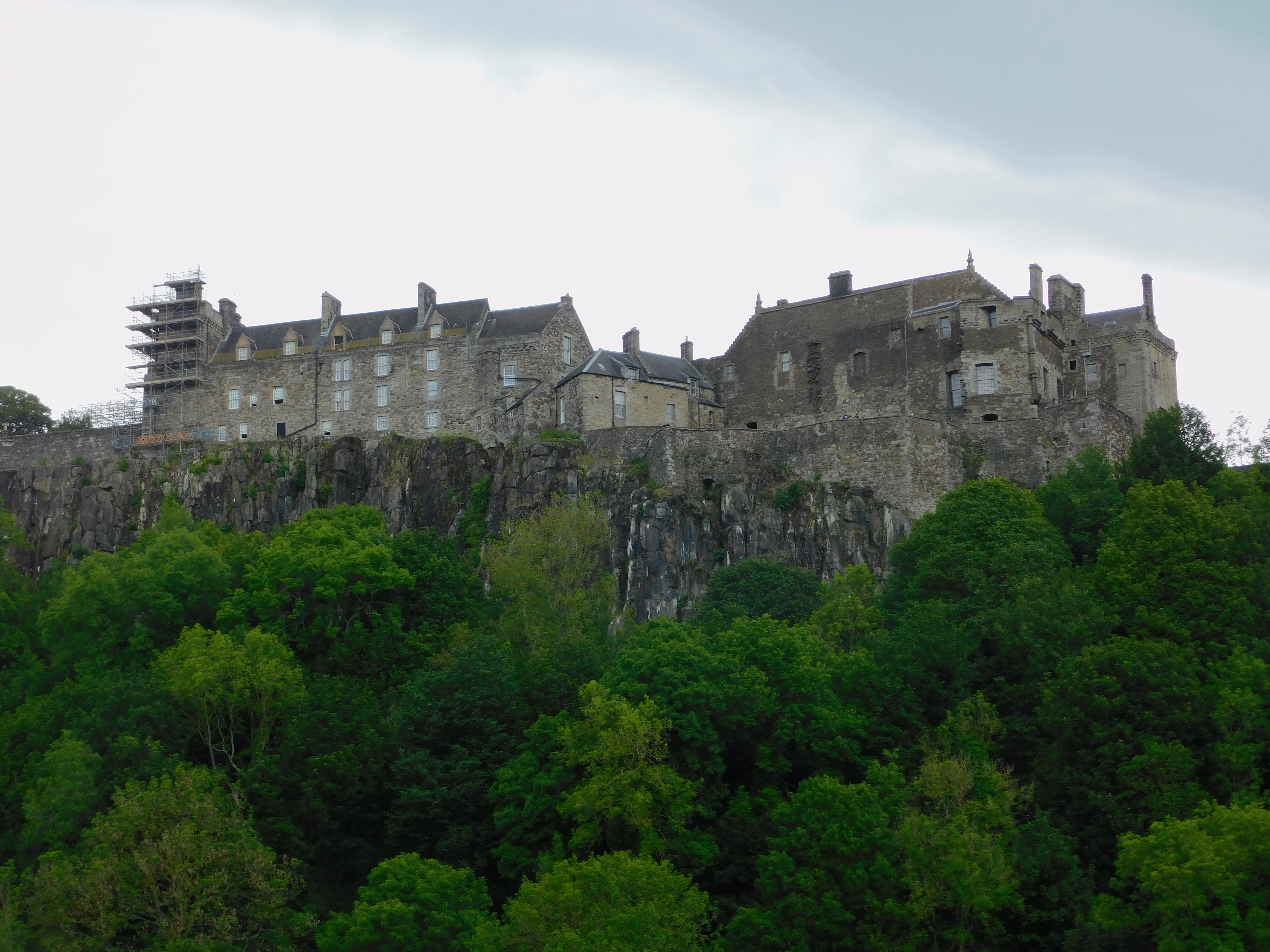
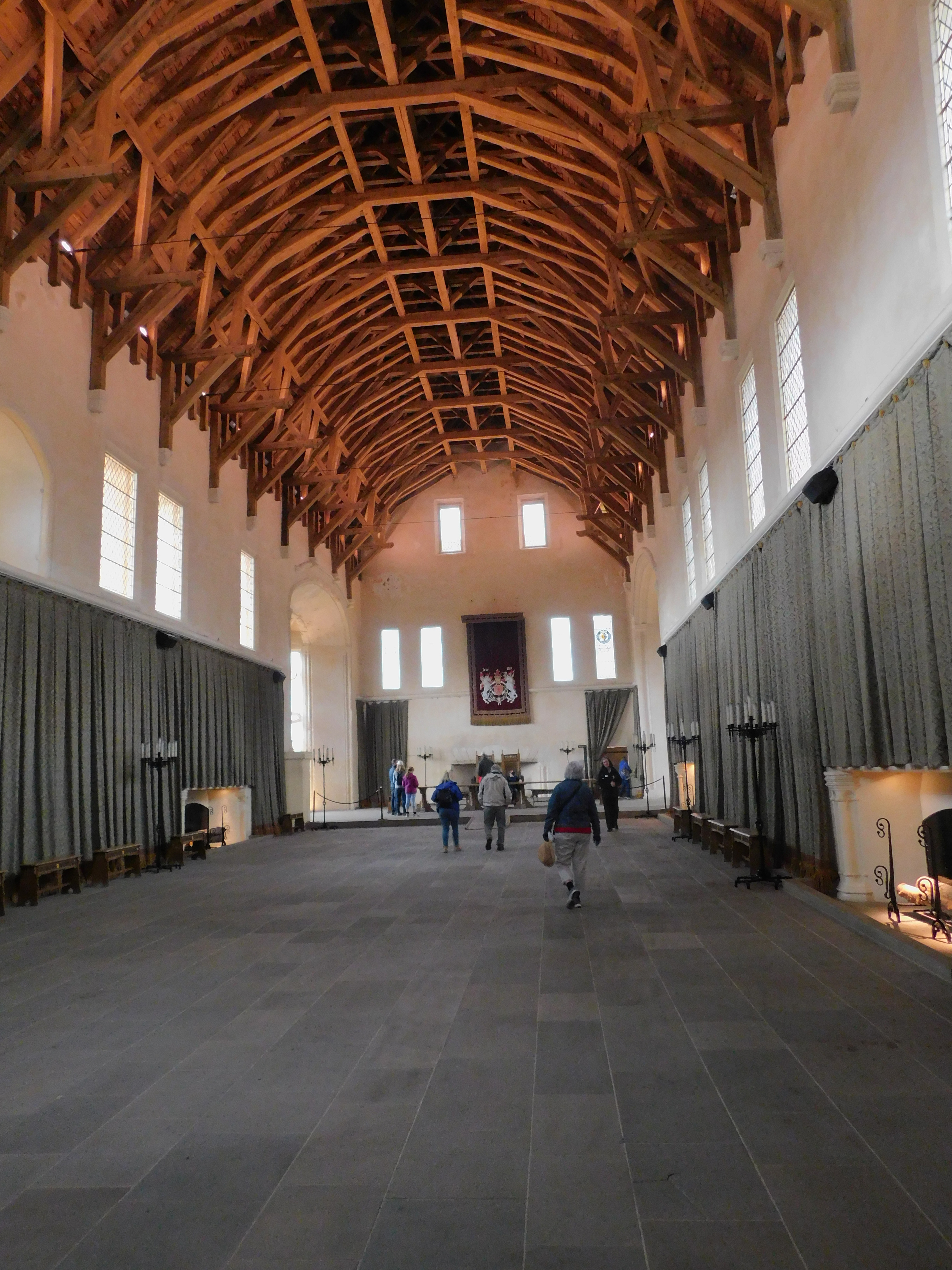
Although it’s been around since at least the early 12th Century, Stirling Castle is best known for the Tudor-Stuart years when Mary Queen of Scots holed up there often. It was laid siege eight times. One of its outstanding buildings is the Great Hall which was restored to its original “hammerbeam” ceiling and parapets, five fireplaces and a dais for the king. We had our picture taken sitting in the king and queen’s seats on the dais.
Ceiling of Great Hall, Stirling Castle
PERTH
From Edinburgh’s central Waverley Station, it was off to our next stop, Perth. As in Liverpool, our AirBnB would’ve been an easy walk from the train with less luggage. (And I say that knowing we had packed pretty light, all things considered.) Another lovely and well appointed flat, complete with breakfast items — cereals, bread and jams, fresh milk in a glass bottle!
We explored Perth and its environs for the better part of five days. A slightly sunny day found us walking along a river path, across a narrow pedestrian walkway as a train whizzed by on the adjacent tracks, then up a short hill to Branklyn Garden. Started in the 1920s by a local couple who collected exotic seeds when they traveled the world, the hilly two acres were a colorful delight. We traversed the winding paths, oohing and aahing at the gorgeous flowers. We bought some seeds to take home to the family gardener, Uncle Victor.
Another more typical overcast and rainy day, we visited Scone Castle (pronounced SKOON locally). It’s the sight of the original Stone of Scone on which Scottish kings were inaugurated. The stone now lays in the crown room at Edinburgh Castle. Furniture from Marie Antoinette and bed hangings worked on my Mary Queen of Scots are interesting, but portraits of two beautiful women are among the most popular historic pieces: Lady Elizabeth Murray and Dido Elizabeth Belle. Dido was the daughter of an English naval officer and an African slave in the British West Indies. Her father Sir John Lindsay (I am a Lindsay on mom’s side but don’t know if he’s in our family tree) took her back to England. His uncle William Murray, Lord Mansfield and Lord Chief Justice, and wife raised Dido as a free gentlewoman, along with another great-niece Lady Elizabeth Murray. Lord Mansfield reaffirmed Dido’s freedom and made her an annuity in his will. He ruled on a significant slavery case in 1792 — he wrote that slavery had no precedent in English common law and had never been authorized under positive law (human-made laws). (Thank you, Wikipedia, for that detail.) A movie “Belle” has been made of Dido’s life. (We weren’t able to get a photo of the paintings.)
One of Scone’s peacocks
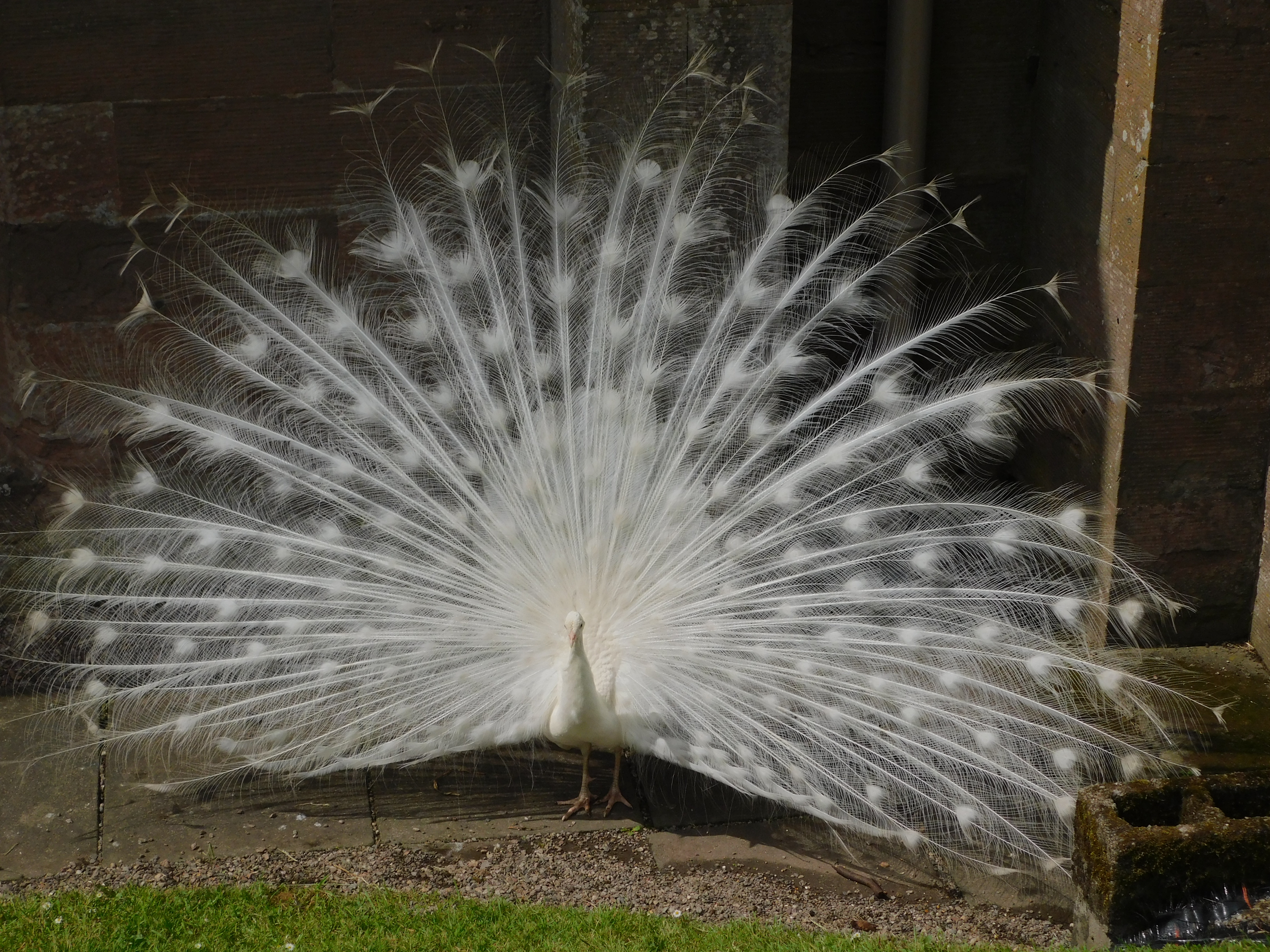
On completing our tour of Scone Castle, we had lunch in the Old Servants’ Kitchen Cafe; we were prepping for a hike around the extensive grounds. Then, dark clouds filled the sky, thunder frightened the flock of peacocks roaming the lawn, and we ran for shelter to await our taxi back to town.
Our time at the Black Watch Museum was among our favorite visits. When we bought tickets, we were asked if we wanted a tour, agreed and explored the first floor of the museum as directed while we waited for the tour to begin. I only wish I could remember all of the stories our guide, a tall, elegant, retired Black Watch officer, shared — he put life into every painting, every exhibit, every historic moment.
The Black Watch is the oldest Highland regiment in Scotland. They’re the guys who wear the black and blue and green tartan kilts and tams with a red hackle (clipped feather) in the band. Created in the early 18th Century, the Black Watch has fought for Britain around the world, including in our Pennsylvania backyards — the French and Indian War. Nine Black Watch bagpipers participated in the funeral processional of President Kennedy. Among the notable members of the Black Watch were actor Stewart Granger, a British light weight boxing champion named Al Foreman, and the last Scottish survivor of World War I combat Alfred Anderson.
No visit anywhere with Glenn is complete until you’ve toured at least one cemetery. And Perth was no exception. We almost missed the narrow path to enter Greyfriars Burial Ground, a remnant of the late 16th Century that has one of the best collections of old gravestones in the country. A group of the oldest have been sheltered under a roof, but many still aren’t readable.
The weather managed to stay dry enough one day to do a couple loads of laundry. We try to book flats with washing machines to help minimize our packing. And we snacked on some delicious treats that our landlady made and dropped off. This was our best AirBnB yet!
GREENOCK, AT LAST!
From Perth, it was on to Greenock via Glasgow. More sheep in the meadows as we traversed the green countryside. Another wait near the Departures board for our train. Time for a quick potty break and bite to eat.
Some of you may know that Glenn and I grew up in Greenock, Pennsylvania (PA), a mostly residential village in a larger township about 25 miles southeast of Pittsburgh. As kids, we were told that Greenock was founded by a Scottish sea captain who named it for his hometown. NOT. Pre-trip, genealogy-king Glenn researched our Mr. William Black, a coal miner (like everyone else who settled in the area) from Glasgow (a bit further up the Clyde River). He could find no indication that Black lived in Greenock, Scotland, but he, his wife and one child are all buried in the original cemetery of the community he named.
On arrival at the below-grade Greenock West station, we lugged our suitcases up several flights of stairs and across the street to the taxi rank. The cabbie asked if we were from the cruise ship. Cruise ships as well as container ships use this port. We responded in the negative and told him of our origins in PA. That apparently made us a source of interest among the cabbies. A few days later, on hearing our accents, our cabbie stated that we must be the couple from Greenock in America. (BTW, there is a Greenock in Australia too.)
Another lovely AirBnB flat, again complete with breakfast foods plus a box of what turned out to be incredible dried-fruit cookies. …and a neighborhood coffee shop within a few blocks. We stopped for coffee a few times, chatting with the women who worked there. It was one of them that told me Greenock has one of only three outdoor swimming pools in the entire country, and it’s salt water. I was wishing I’d brought my swimsuit.
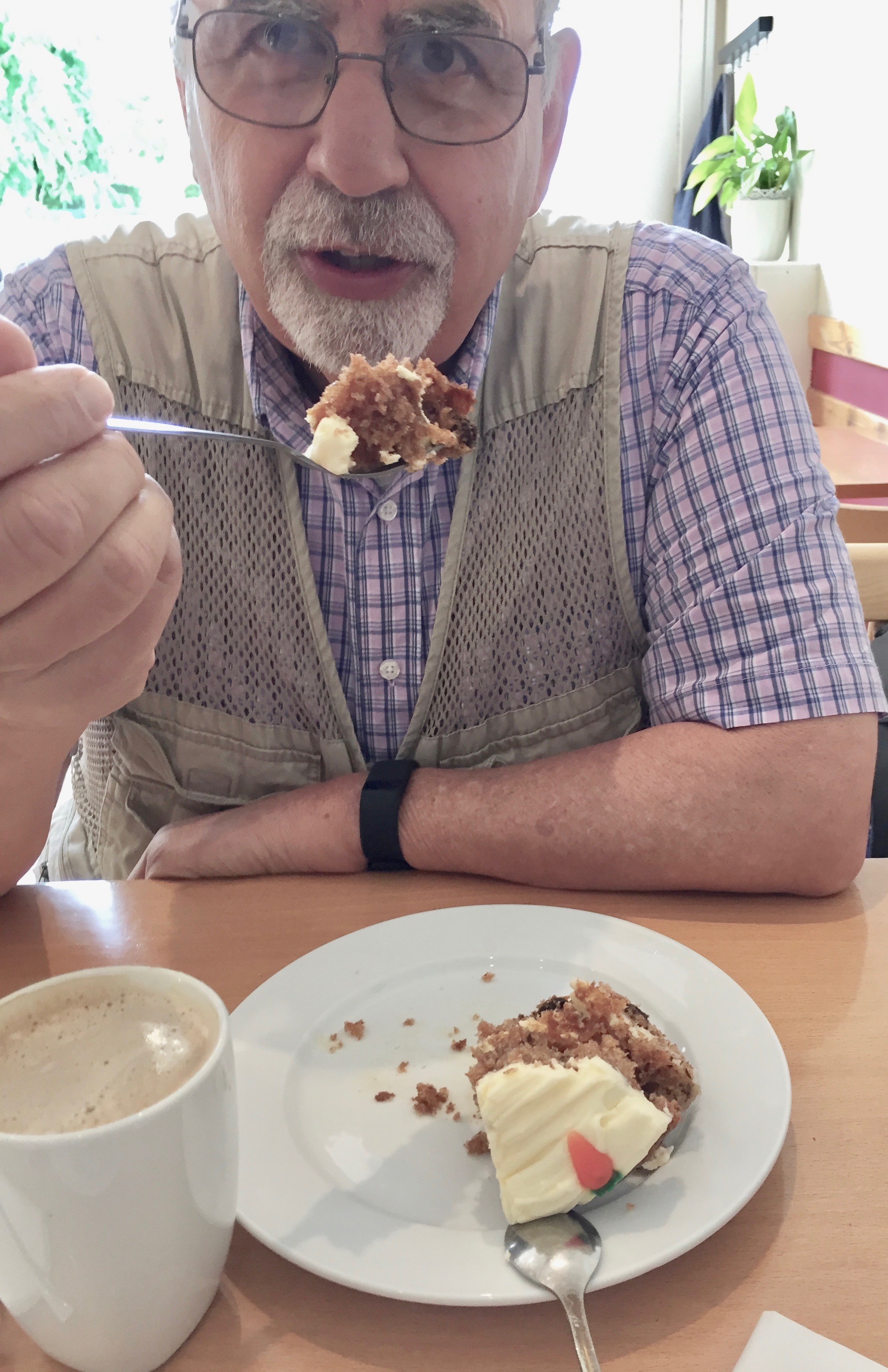
The traditional haggis, neeps and tatties were on the cafe’s “daily special” but until our last visit, Glenn steadfastly refused to try the haggis (for breakfast, he did consume a substantial piece of THE best carrot cake I’ve ever tasted). The cook said he couldn’t leave Scotland without trying haggis. On our afternoon coffee break stop, she brought him a cup which he gingerly tasted, then polished off. I don’t think her recipe followed the tradition of ground sheep entrails, barley, other grains, and spices all steamed in a sheep stomach, but whatever she did, it was tasty. (BTW, neeps are mashed turnips and tatties, mashed potatoes, in the local lingo.)
Haggis later, but first, carrot cake
In our five days in Greenock, we thoroughly explored the city — birthplace of James Watt, inventor, engineer and chemist who improved on the steam engine, making much of the Industrial Revolution possible. Unfortunately McLean Museum was closed; it has an extensive Watt exhibit. A cemetery plaque said novelist John Galt was buried therein but we never found his grave. Galt has been called the first English political novelist because he dealt with issues around the industrial revolution.
Aside: Among other Greenockians are the mothers of two famous American entertainers Jay Leno and Julianne Moore; both mothers were born in Greenock (thank you, Wikipedia, for that tidbit).
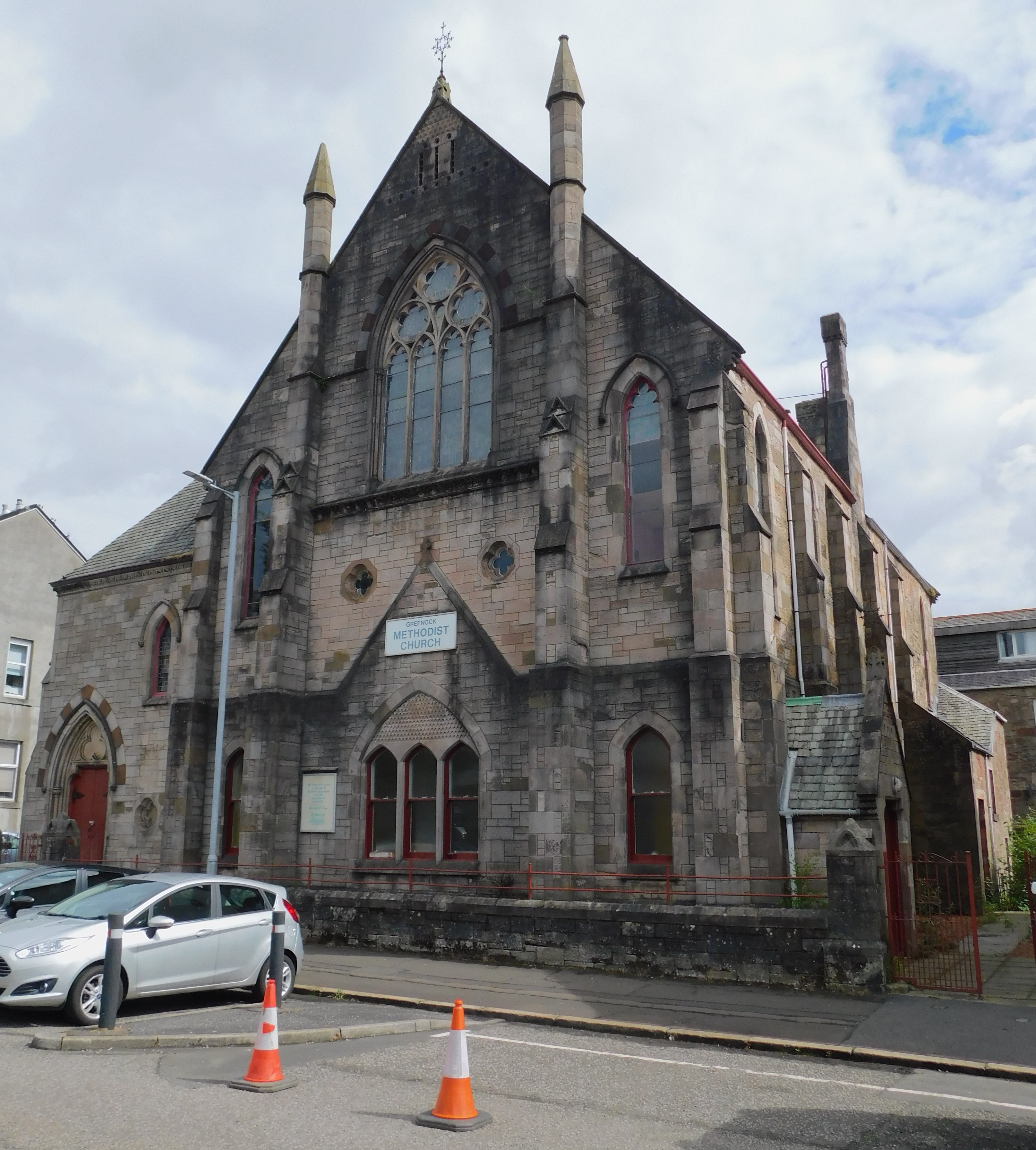
Glenn photographed scores of churches, some still active, some closed or serving a new purpose. One is now a furniture store. The Old West Kirk (church) built at the end of the 16th Century is supposedly the first Protestant church built in Scotland after the Reformation. The closed Greenock Methodist Church (Glenn’s family attended the one in PA) now holds services in an Episcopalian church.
Greenock Methodist Church
We walked the mile-long Esplanade along the Firth of Clyde past villas previously owned by shipbuilders and other captains for industry, Glenn snapping pix all the way. (A firth is similar to a fjord, an inlet.) Then we continued to Gourock in search of an ice cream parlor I’d been to several years ago. Didn’t find it but the five-mile walk easily justified dessert in Gourock and a one-pound train ride back home; the one time I didn’t have our BritRail passes along.
From Greenock, we made two day trips, one to Glasgow (mostly to visit Kelvingrove Art Gallery and Museum) and the other to Stevenston (my mom’s birthplace). We walked between Glasgow Central Station and the museum, a long, long way, and stopped for lunch and respite at a wonderful Indian restaurant.
I’m sure my late mother ordered sunshine and warm weather for Glenn’s first trip to Stevenston. I’d always driven there before so had no idea where we were when we got off the train. We walked … and walked … and finally came to a familiar location. Of course, we went to the cemetery but also wandered the town. Unsuprisingly nothing had changed since my last visit in 2016. We even lunched in the garden of the only decent eatery, a pub/cafe. Glenn’s beer, though dark in color, was quite light in body and came in a glass with an elephant stem. I left five pounds and a note, and we took the glass for his daughter Michelle who collects elephants. Made it all the way to Berlin PA in one piece!
The night before we left Greenock, our landlord and two children stopped by. It was fun to meet them; his pregnant wife was resting at home while he took the two pre-schoolers out for some pre-bedtime exercise. Our flat had been their home when they got married. Now they’re renovating a third to accommodate their bigger family.
At the crack of dawn on the morning we left Greenock, we taxied to Greenock’s Central Station to avoid the stairs we’d encountered on arrival at West. Train change in Glasgow, more staring at the Departures board, a chance to kibbutz with others in line for the Virgin train to London. In front of us were two women who had been fly fishing in the far north of Scotland for two weeks. Fresh fish to eat every day. They had more luggage than we did, including a large black zippered cloth case. Not fishing equipment, we learned, but a keyboard. The woman carrying the bag is a pianist and exercises her fingers on the keyboard daily — even on her annual fishing trips.
Our overnight hotel was closer to Heathrow Airport than the city, so our taxi inched through rush-hour London from Euston to Paddington where we caught a train to Heathrow, and from there, a taxi to the hotel. Whew! But we had a relaxing and pleasant evening before heading out the next day for home — or rather, Dulles. Glenn’s cousin Donald met us at Dulles, and the next day we drove back to Pittsburgh.
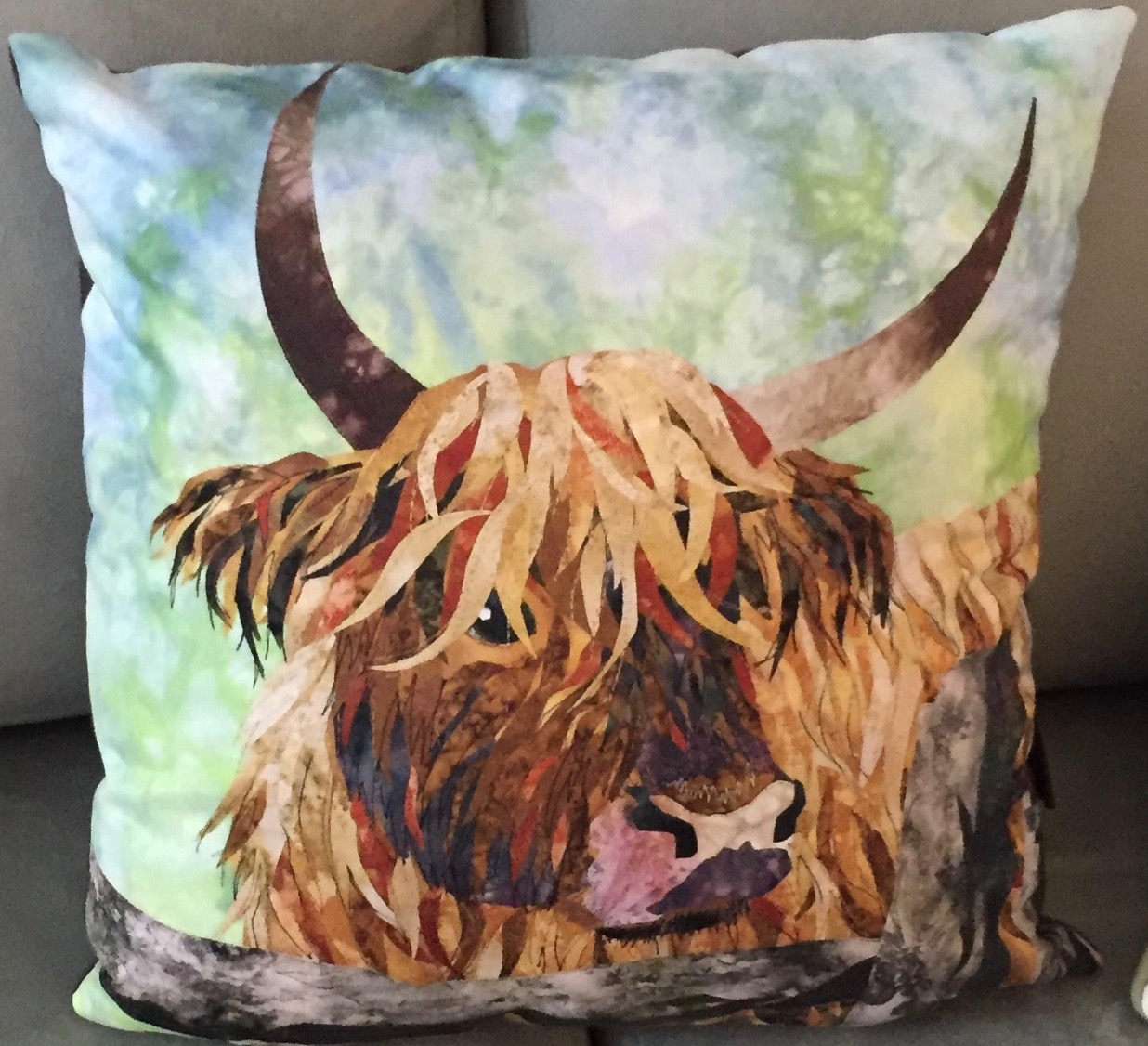
Hairy Coo … Highland Cow … to remind us that the advendure is only over for now.
 Hello All from Suzi