I’m grounded, like many/most/all of you, by a global pandemic. I thought I’d have more time to write, post more often on how coronavirus has changed what we do, how we work and live. Or not. Perhaps write on lighter topics. I started … and got stalled. Then I signed up for a writing class at Osher LifeLong Learning Institute at Carnegie Mellon University. For those of you not familiar with Osher or OLLI, the short version is that it’s a university-based program that offers courses to seniors, many taught by retired profs as well as others with knowledge/experience in a topic and interest in sharing it. I started a couple of years ago with a knitting class, renewing my interest in an old hobby. I’ve also taken classes on women mystery writers, wine, right-wing authoritarianism (FYI, there’s no such thing as “left wing authoritarianism”), and crocheting.
In each weekly writing class, we’re given a theme or topic to write about in 10 minutes, then we share. Reminds me of J-school. Each week we also submit a 1200-word piece for everyone to read and critique via email and to discuss at the next class (Zoom, of course). That’s truly inspired me and moved me off “square one” in completing the book I’ve been writing about my son Peter’s journey.
For today, and likely in the future, I’ll share some of the weekly writing exercises. Nothing too serious, definitely nothing political. Each another piece of me.
“I think that I shall never see
“A poem lovely as a tree.”
Joyce Kilmer
Much of my early 1950s childhood was spent playing in the woods around our house. Ours was the first house built on a dirt-only street that led through a former farm that had included a big orchard and lots of woods. Our house was built in part of the old orchard. My brother, our friends and I played Captain Video in the low crotch of the three peach trees that Daddy saved from the bulldozers.
As we grew up, we ventured farther afield for our adventures — as much out of necessity as curiosity. More houses were added to our street, more streets to our neighborhood as the developer marched through the farm he’d acquired.
Christmas trees weren’t a part of our mother’s Scottish heritage, and our Hungarian father’s family couldn’t regularly afford one. But we, the typical American family, had one. And on Christmas Eve Daddy went on an annual mission to buy the cheapest tree he could find, Scotch pine preferred. He couldn’t imagine spending $5 (average price then) for a “dead tree.” The tree I remember best was in the mid ‘50s. It cost 50 cents and would’ve looked perfect in a Charlie Brown cartoon with its seven branches on a five-foot trunk. No amount of tinsel, lights, popcorn strings and colored balls could hide its sparseness … but we tried.
Off to college I traded my childhood woods for a campus that was set along the shore of Lake Michigan and among an abundance of trees. Different kinds of adventures, not least of which was avoidance of the many squirrels that cavorted among the trees. I’d never really feared them until I read in the student handbook that they could be rabid. Oh, and if you’re bitten, bring the offending animal with you to the health service. Right.
One college summer I worked as a counselor at a church camp. My 10-year-old charges, with help from myself and a co-counselor, built a treehouse along the bank of the creek that flowed through the camp. What fun it was to help those kids learn to pound nails and build something (good intro into a “lesson” on the crucifixion … or not). We held our week’s end meeting in our new house.
Years later my toddler son had a tree house. Sadly it was freestanding, part of the property when the house was purchased. But he also had a huge elm tree in the backyard … and tree privileges for those days when he couldn’t quite get to the bathroom in time. When his dad was in New York doing post-graduate work, he and I planted a black walnut twig in the front yard. Slow growing and late blooming, it challenged us each year to have hope that it would flourish. That it did for many years … then a violent windstorm cut its life short.
Fast forward. my son has graduated from high school, and I’ve flown off to Poland as a Peace Corps volunteer. Although much of Poland was deforested during World War II, fast growing trees, not always indigenous, were replanted and grew into beautiful forests. I don’t know if Polish has a word for “woods,” but “las” means “forest.” So like my Polish friends, I referred to any large body of trees as a forest. Now I’m back in Pittsburgh and ever time I refer to the woods as a forest, my signifiant other just shakes his head and smiles.
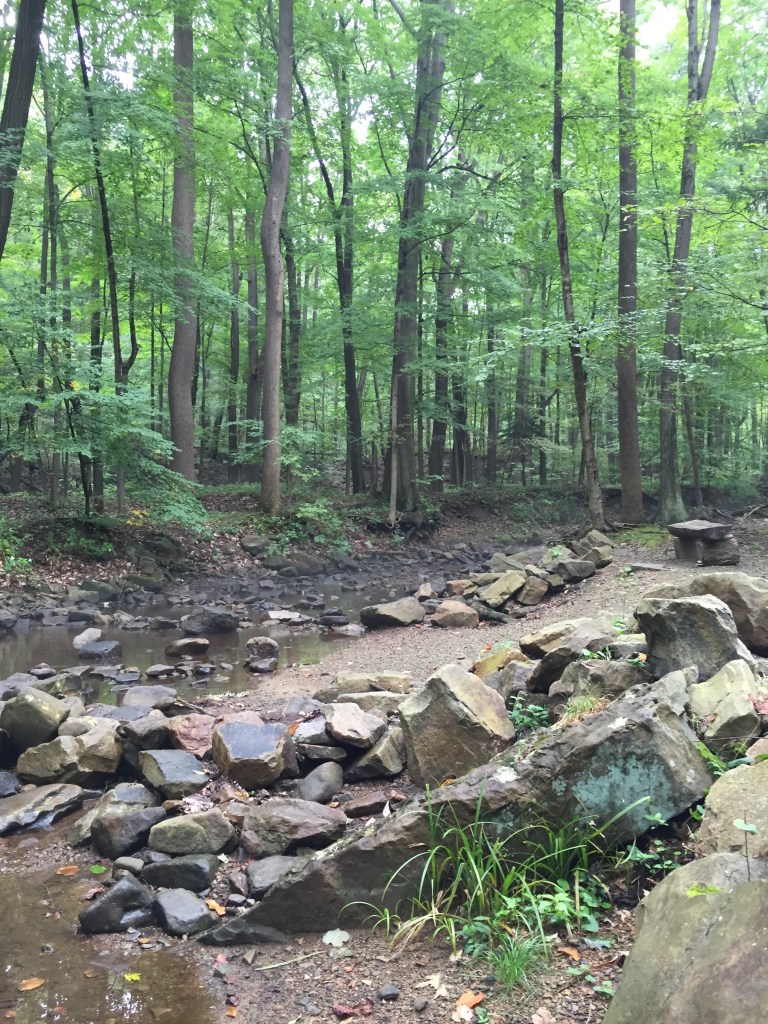
My spiritual home has always been Linn Run State Park near Ligonier. Trees, trees and more trees. Our family started going Linn run when I was a toddler, and we went frequently throughout my growing-up years. Many times we kids walked across the creek on fallen tree trunks … and established the family tradition of falling into the creek. My son and I went there when my father died in the early ‘90s. Another family, with young children, was there for a photo session of kids sitting on a log over the creek. Because the children were young and fearful, my son rolled up his pant legs, waded into the creek, carrying each to the center of a log and standing nearby but outside the photo, then he carried them safely back.
The pandemic has seen me walking more since my water exercise classes at the JCC were curtailed. The path along the Allegheny River — lined with trees, sculptures, memorials to war heroes and sports’ greats — is a favorite. Over a few weeks friends and I were appalled to see park department staff chopping down healthy trees. Most recently, they were back, planting new trees where they’d removed others. We found someone to question and were told the “old” trees weren’t indigenous and the new ones are. Go figure.
“Poems are made by fools like me,
“But only God can make a tree.” (JK)
 Hello All from Suzi